The “root cause” of acne: is it a hormone imbalance?
There’s a lot of talk about “root cause” of acne on the internet, giving the impression that if you are able to find and isolate this “one thing”, your acne will be a thing of the past.
Spoiler alert: helping patients reduce / manage their acne has more to do with looking at a few different areas of their health vs doing “one thing” that will get rid of it once and for all.
I know, I know, you’re thinking: but I don’t want to “manage” it, I want to “cure / get rid of it forever”!
I get it, acne suuuuucks.
But I want to be honest with you about what we do and don’t know so you can make the best decision for you.
So, why does acne happen and why is it usually worse before your period? Are your hormones imbalanced?
Let’s talk about it, shall we?
Acne + Hormones - quick recap:
Ok, before we dive in, let’s revisit some key hormone points really quick:
Follicular phase = day 1 of period to when you ovulate
estrogen more active in this phase
Luteal phase = after ovulation to day 1 of period
progesterone more active in this phase
New hormone on the scene:
Testosterone = a hormone that is part of the group of male sex hormones called “androgens”; levels found typically higher in males vs females and responsible for key male characteristics (deeper voice, body hair, libido, sexual function, etc).
It’s important to note that females ALSO have testosterone naturally circulating in their bodies with lower levels than males
If these levels are higher than what we like, for example, in PCOS, that’s a totally different circumstance and not something that will be discussed in this writing
Ok, let’s get into it:
Most menstruating folks with acne notice it gets worse in the luteal phase of their cycle, with 39-85% impacted, especially in those over 30 years of age.
Why does this happen?
We will break it down into 2 different areas:
1 = estrogen level relative to testosterone level
2 = genetics + androgen levels + skin sensitivity
Estrogen + Testostone levels:
Well, what we see during the luteal phase is that RELATIVE to testosterone, the level of estrogen is lower (it did its thing in the follicular phase, now it’s “napping”, in a sense). This relative increase of testosterone is thought to be why folks see an increase in acne breakouts.
Another way to say this is that the testosterone level stays the same while at the same time, the estrogen level drops.
One REALLY important thing to keep in mind when reading that: This. Is. NORMAL. Your estrogen is doing what it's supposed to be doing over the course of your cycle.
So are your hormones out of balance? In a sense, yes.
Is that imbalance pathological / does it mean there’s an issue with your hormones? No.
Is it annoying for folks with acne? Absolutely.
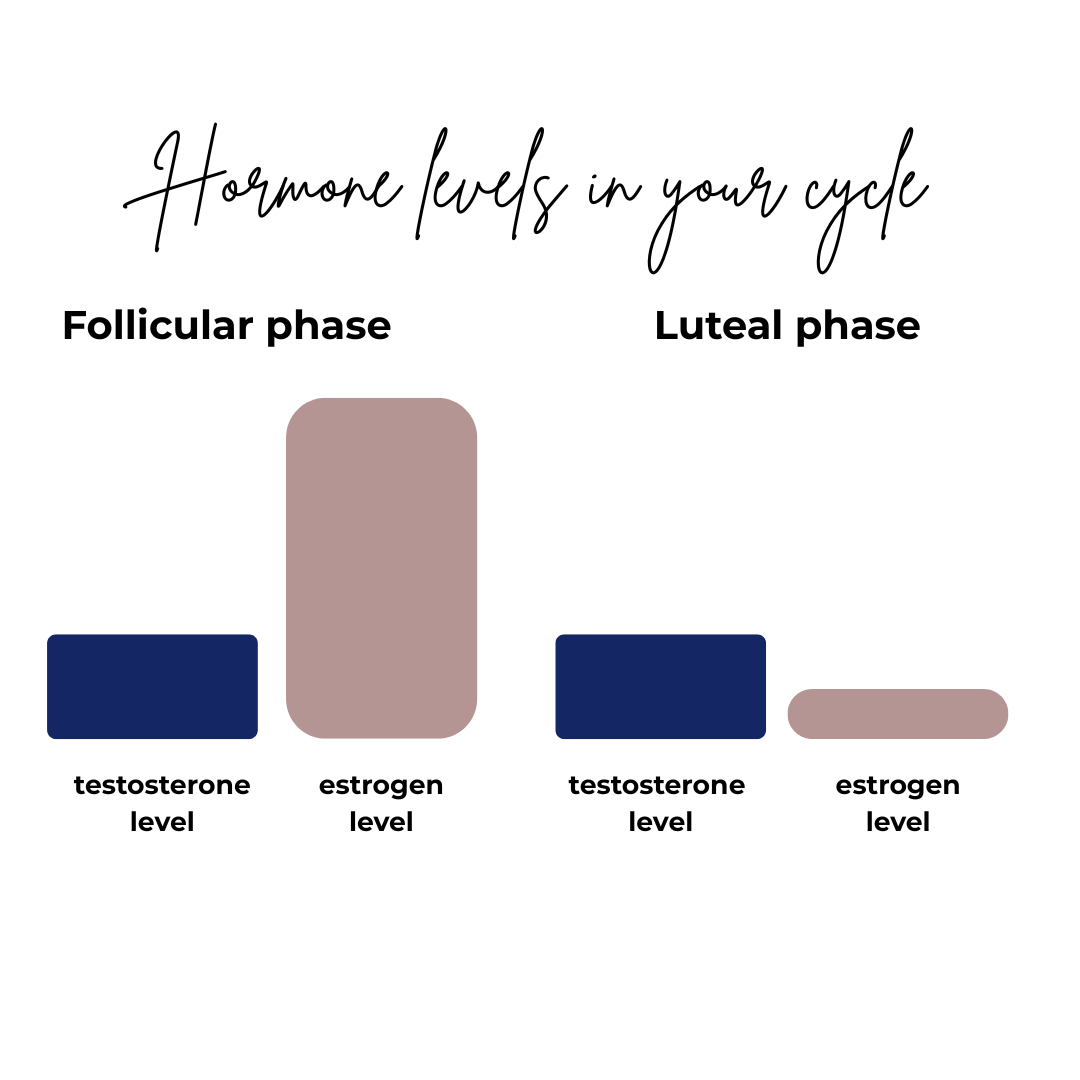
A quick visual to help illustrate the relative levels of testosterone & estrogen in different parts of the menstrual cycle
Androgen levels + skin sensitivity + genetics:
Now, the sebaceous glands (part of the skin that secrete sebum aka oil) in the skin are really sensitive to hormonal fluctuations (like testosterone) and play a big role in acne.
Not everyone is as susceptible to acne as others. In folks who are susceptible to acne (thanks to genetics), their bodies produce more androgens in the skin.
They’re also more sensitive to the effects of these androgens.
And they also can have more peripheral conversion of androgens at the skin level, which makes things even worse.
It’s like a trifecta of acne hell.
So how are these androgens impacting the skin? It looks like this:
Increased oil production (hello clogged pores)
Hyperkeratinization (hello more dead skin cells that can block pores)
more inflammation
The oily environment = happy environment for acne causing bacteria
Should you get your testosterone levels checked? Maybe, maybe not.
Why?
Because circulating testosterone hasn’t been typically shown to be related to acne.
The ACTUAL issue is the conversion that takes place at the skin.
A note on the sebaceous gland: it’s considered to be a neuroendocrine gland, meaning it’s influenced by many different hormones, not just female and male sex hormones. Stress hormones, hormones related to growth, metabolism, vitamin D and more can all impact it.
Why the heck do we care that it’s influenced by all these hormones?
Because when we talk about supporting acne, knowing that information means we have a variety of ways to help reduce the annoying break outs and / or severity of them.
This is why acne is talked about as more of a management situation vs a “cure” situation.
So if you’re tired of your annoying acne + limited success in the past, reach out to schedule a complimentary meet & greet to see what working together would look like for you!
Dr Stacy Burke, ND
References:
A.U. Tan, B.J. Schlosser, A.S. Paller. A review of diagnosis and treatment of acne in adult female patients. International Journal of Women's Dermatology, 2017
Yuwei Li, Xinhong Hu, Gaohong Dong, Xiaoxia Wang, Tao Liu. Acne treatment: research progress and new perspectives. Frontiers in Medicine, 2024
Edileia Bagatin, Thais Helena Proença de Freitas. Adult female acne: a guide to clinical practice. Anais Brasileiros de Dermatologia, 2019
Mallikarjun Vasam, Satyanarayana Korutla. Acne vulgaris: A review of the pathophysiology, treatment, and recent nanotechnology based advances. Biochemistry and Biophysics Reports, 2023
Amita H. Sutaria; Sadia Masood; Haitham M. Saleh; Joel Schlessinger. Acne Vulgaris Statpearls. August 17, 2023.